Marine Snow and the Reef Aquarium
Walk along a coral reef on a calm tropical afternoon and the water may appear crystal clear. Yet beneath that apparent clarity drifts an astonishing abundance of microscopic life and organic material. Tiny aggregates containing bacteria, algae, mucus, proteins, detritus, minerals, and countless other particles slowly tumble through the water column like an underwater snowfall. Collectively, these suspended aggregates are known as marine snow, and despite their humble appearance, they constitute one of the most important pathways by which energy and nutrients move through marine ecosystems.
To many reef aquarists, coral nutrition is synonymous with zooplankton. Copepods, rotifers, Artemia, and powdered coral foods all certainly have their place. Yet decades of marine ecological research have demonstrated that many reef organisms obtain a substantial portion of their nutrition from much smaller suspended particulate matter. In fact, numerous suspension-feeding animals spend every hour of every day harvesting these drifting particles from the water column. Gorgonians, feather duster worms, sponges, tunicates, bivalves, azooxanthellate corals, and even many photosynthetic stony corals continuously exploit this resource.
Nature rarely delivers these particles as isolated fragments. Rather, they are packaged into nutritionally enriched aggregates that become progressively more valuable as they drift through the ocean. Understanding how these aggregates form—and why corals have evolved to exploit them—provides valuable insight into one of the reef aquarium hobby's most overlooked food sources.
What exactly is marine snow?
Marine snow is generally defined as an aggregate of suspended particulate organic matter (POM) that forms naturally within aquatic environments. These aggregates range in size from a few hundred micrometers to several centimeters in diameter and are composed of an extraordinarily diverse mixture of biological and inorganic materials.

The ingredients vary from one ecosystem to another, but commonly include:
Dead phytoplankton
Zooplankton molts and exoskeleton fragments
Fecal pellets
Coral mucus
Detrital plant material
Bacterial biofilms
Fungal cells
Protozoans
Mineral dust
Clay particles
Tiny shell fragments
Transparent exopolymeric particles (TEPs)
Rather than representing "dead waste," marine snow is better viewed as a living microbial ecosystem. Each aggregate serves as a miniature biological reactor inhabited by bacteria, archaea, protists, fungi, microalgae, and viruses. These microorganisms continually modify both the physical structure and nutritional composition of the aggregate as it drifts through the water.
Marine snow therefore represents far more than a collection of particles—it is an evolving community whose value increases as microbial colonization progresses.
The snowball effect
One of the more fascinating aspects of marine snow is that it develops through a genuine snowball effect.
The open ocean contains enormous quantities of dissolved and colloidal organic matter. Much of this material consists of particles so small that they cannot be efficiently captured by suspension-feeding animals. On their own, these microscopic fragments remain nutritionally inaccessible despite representing an immense reservoir of organic carbon.
Aggregation changes everything.
Tiny particles begin sticking together through a combination of physical collisions and biological adhesives. Ocean turbulence causes repeated contact between suspended particles, while microorganisms actively promote aggregation by secreting sticky extracellular polymers known as transparent exopolymeric particles, or TEPs.
TEPs are primarily composed of acidic polysaccharides secreted by phytoplankton, bacteria, macroalgae, corals, and many other marine organisms. Although virtually invisible individually, they behave much like microscopic glue suspended throughout seawater.
As additional particles become trapped within these sticky matrices, aggregates rapidly increase in size.
What begins as dispersed microscopic debris gradually becomes a porous, irregular particle large enough to capture still more material. Bacteria colonize its surface. Protozoans begin grazing on those bacteria. Additional organic debris becomes embedded within the growing structure. Eventually, the aggregate becomes sufficiently dense that gravity slowly overcomes buoyancy and the particle begins its descent through the water column.
Every centimeter traveled increases the probability of encountering additional organic matter, bacteria, and plankton.
The snowball continues to grow.
A living microbial ecosystem
One reason marine snow has attracted such intense scientific interest is that microbial densities within these aggregates can exceed those of the surrounding seawater by several orders of magnitude.

To bacteria, marine snow represents an oasis. The surrounding open ocean is often surprisingly nutrient-poor. Within a marine snow aggregate, however, microorganisms encounter concentrated amino acids, carbohydrates, lipids, vitamins, trace minerals, and reduced carbon compounds. These resources support rapid microbial growth, allowing bacterial populations to flourish. This colonization profoundly alters the nutritional value of the particle.
As bacteria multiply, they synthesize microbial proteins, carotenoids, fatty acids, enzymes, cofactors, vitamins, and countless secondary metabolites. Some bacteria release digestive enzymes that partially hydrolyze otherwise indigestible organic matter, making nutrients more available not only to themselves but also to higher consumers. Consequently, a particle that initially consisted largely of refractory detritus gradually transforms into a protein-rich microbial consortium.
This process helps explain why many suspension feeders exhibit remarkable selectivity when feeding. Laboratory studies have shown that numerous corals discriminate among suspended particles, preferentially ingesting those enriched with microbial biofilms while rejecting nutritionally inferior debris. To a coral polyp, microbial conditioning is often as important as particle size itself.
Marine snow on coral reefs
Marine snow also performs one of the ocean's most important ecological functions: Transporting energy from sunlit surface waters into deeper ecosystems.
Primary production occurs largely within the upper, illuminated layers of the ocean where phytoplankton and zooxanthellae utilize solar energy to convert inorganic carbon into biomass. Without a mechanism to transport this organic matter downward, deeper marine ecosystems would remain chronically energy-limited.
Marine snow provides that mechanism. As aggregates slowly sink, they transport organic carbon through the water column in what oceanographers refer to as the biological carbon pump. Along the way, countless organisms intercept these drifting particles. Although marine snow is commonly associated with the open ocean, coral reefs both receive and produce enormous quantities of these aggregates.
Ocean currents continuously deliver offshore marine snow onto reef systems, bringing with them nutrients generated hundreds or even thousands of kilometers away. Simultaneously, reef organisms manufacture their own particulate resources. Corals themselves are among the largest contributors.
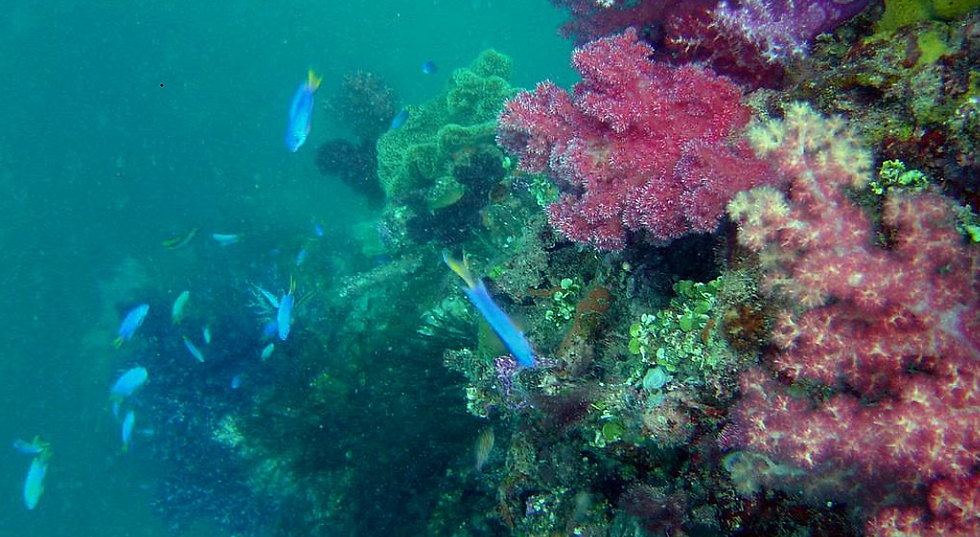
Healthy corals constantly secrete mucus across their surfaces. This mucus serves numerous purposes, including sediment removal, pathogen defense, UV protection, and lubrication. Once released into the surrounding water, however, it becomes one of nature's most effective particle traps.
Within hours, coral mucus can become transformed into a nutritionally enriched marine snow particle teeming with microbial life. Some of these particles drift away to nourish neighboring ecosystems. Others remain on the reef where they are intercepted by suspension feeders—including, remarkably, the very corals that produced the mucus in the first place. This remarkable recycling loop allows reefs to retain valuable nutrients within otherwise nutrient-poor tropical waters.
Every reef animal eats differently
Marine snow is unusual because no two reef organisms exploit it in quite the same way.
Large-polyped stony corals often capture aggregates directly with mucus-coated tentacles before transporting them toward the mouth. Small-polyped species intercept finer suspended particles using elaborate ciliary currents and mucus films spread across the colony surface. Sea fans and gorgonians orient their branching colonies perpendicular to prevailing currents, maximizing encounters between drifting particles and their polyps.
Feather duster worms extend delicate radioles into the flow, sieving particles according to size before sorting them toward the mouth.
Sponges employ perhaps the most extraordinary feeding mechanism of all. Millions of choanocyte cells continuously pump water through intricate canal systems, removing bacteria and ultrafine particulate matter that many other animals cannot efficiently exploit.
Tunicates, barnacles, bryozoans, crinoids, Christmas tree worms, flame scallops, oysters, and tridacnid clams all contribute their own specialized filtering strategies, each targeting a slightly different portion of the suspended particle spectrum.
Even many reef fishes benefit indirectly. Copepods, amphipods, mysids, worms, and other microfauna feed upon marine snow, converting microbial biomass into larger prey that ultimately enter higher trophic levels. Rather than serving a single organism, marine snow functions as a nutritional bridge connecting microbes, invertebrates, fishes, and corals into one continuous food web.
Recreating one of the reef's most important nutritional pathways
Understanding how marine snow functions on natural reefs inevitably leads to another question: Why don't we observe abundant marine snow in our aquariums?
After all, healthy reef aquariums contain corals, bacteria, detritus, dissolved organic matter, and plenty of water movement. On paper, they possess many of the ingredients necessary for marine snow formation. Yet most aquarists rarely witness the persistent clouds of suspended aggregates that characterize many natural reef environments.
The answer lies not in what aquariums contain, but in what they are designed to remove.
Modern reef systems are exceptionally efficient at exporting suspended organic matter. Filter socks, roller mats, fleece filters, protein skimmers, UV sterilizers, and high-flow circulation all act to intercept or destroy developing aggregates before they can mature. Even when particles begin to flocculate, powerful circulation pumps often shear them apart long before microbial communities have an opportunity to colonize and enrich them.
Residence time is equally important. In nature, a marine snow particle may drift for days or even weeks while continuously accumulating bacteria, microalgae, dissolved organic compounds, amino acids, vitamins, and trace elements. During this journey it becomes progressively more nutritious.

Within an aquarium, however, suspended particles may encounter mechanical filtration within minutes. As a result, many reef tanks contain plenty of suspended particulate organic matter, yet relatively little microbially conditioned particulate matter—the very material that numerous suspension-feeding organisms evolved to exploit.
Simulating a natural process
PNS YelloSno™ was developed to reproduce the biological characteristics of marine snow rather than merely its appearance.
Instead of manufacturing inert particles, Hydrospace designed a process that intentionally mimics the ecological succession occurring during natural marine snow formation.
During production, naturally derived chitin particles serve as microscopic "seed particles," analogous to the cellulose fragments, zooplankton molts, shell fragments, and other nuclei around which marine snow develops in the wild. PNSB colonize these particles, producing extracellular polymers that promote aggregation while simultaneously enriching each particle with microbial biomass and fermentation products.
The resulting product is not intended to be an exact replica of every marine snow particle found in nature—an impossible goal considering the extraordinary diversity of natural aggregates—but rather a biologically inspired simulation that reproduces many of the nutritional and structural features that make marine snow such an important reef food source.
Why purple nonsulfur bacteria?
Purple nonsulfur bacteria have long attracted attention in aquaculture because of their exceptional nutritional profile. Nutrient-dense, a relatively small amount of PNSB biomass goes a long way. Depending upon culture conditions, many species contain up to 70% crude protein on a dry-weight basis while also supplying essential amino acids, carotenoids, lipids, trace minerals, and B vitamins. Their digestibility has prompted researchers to investigate them as ingredients in feeds for shrimp, finfish, mollusks, and other cultured animals.
Their ecological relevance makes them even more interesting. Members of this diverse bacterial group occur in freshwater, estuarine, and marine environments throughout the world. They have been recovered from sediments, microbial mats, macroalgal surfaces, mangrove systems, coral skeletons, the gastrointestinal tracts of marine animals, and indeed coral mucus. Several studies have also detected phototrophic bacteria associated with marine snow aggregates themselves—serving as the inspiration for Hydrospace's PNS YelloSno™.

Although individual PNSB cells are typically only one to two micrometers in length—too small to be efficiently captured by some suspension feeders—their attachment to larger particulate aggregates changes everything. Once incorporated into marine snow-like particles, they become available to feather duster worms, flame scallops, crinoids, barnacles, soft corals, large-polyped stony corals, and countless other filter feeders that specialize in larger suspended particles. Rather than feeding isolated bacterial cells, these animals consume entire microbial communities.
More than protein alone
Marine snow is valuable not simply because it contains protein, but because it delivers a remarkably complete nutritional package. As bacteria colonize organic aggregates, they synthesize vitamins, cofactors, enzymes, pigments, membrane lipids, nucleotides, antioxidants, and numerous metabolites that become incorporated into the particle. These microbial products often represent a substantial portion of the aggregate's nutritional value.
One vitamin deserves particular attention: cobalamin, better known as vitamin B₁₂.
Vitamin B₁₂ can only be synthesized by certain bacteria and archaea, yet it is required by an enormous diversity of marine organisms, including many algae, invertebrates, and fishes. Numerous phytoplankton species are auxotrophic for B₁₂, meaning they cannot produce it themselves and instead rely upon bacterial partners. The same appears to be true for the dinoflagellates (family Symbiodiniaceae), or "zooxanthellae," that live within reef-building corals.
Increasing evidence suggests that bacterial production of cobalamin contributes to the nutritional interactions occurring within the coral holobiont. Concentrations of vitamin B₁₂ measured within coral tissues are often substantially higher than those found in surrounding seawater, indicating that microbial production and exchange likely play important ecological roles.
PNS YelloSno contains high concentrations of B vitamins—particularly vitamin B₁₂, giving the product its characteristic golden-yellow coloration.
Prime time
Experienced reefkeepers often observe that corals do not immediately extend their feeding tentacles when food enters the aquarium. Instead, many species exhibit a preparatory phase during which mucus production increases, tentacles expand, and ciliary currents intensify. On natural reefs, this response rarely begins with large prey items.
Instead, corals first encounter a gradual increase in dissolved compounds, bacteria, and suspended particulate matter associated with approaching marine snow and planktonic blooms. These smaller nutritional signals appear to prepare colonies for subsequent feeding opportunities. PNS YelloSno can be used in much the same way.
It is possible to "prime" captive corals for feeding using YelloSno. Such can be accomplished by adding a modest amount of YelloSno to a region of moderate flow approximately 10 to 20 minutes before target feeding.

This initial application creates a suspension of microbially enriched particulate matter throughout the aquarium. After allowing sufficient time for corals to expand and begin producing feeding mucus, introduce larger foods such as rotifers, copepods, Artemia, Reef Chili®, Reef Roids®, frozen plankton, or other preferred diets. Many aquarists report noticeably stronger feeding responses when using this two-stage approach. While individual species vary in responsiveness, the sequence closely resembles the progression of suspended particulates that may precede larger prey on natural reefs.
Feeding recommendations
For routine aquarium use, use up to 1 mL of PNS YelloSno per gallon of total system volume daily. Because every reef aquarium differs in biomass, filtration, and nutrient export, this recommendation should be viewed as a guideline rather than a rigid prescription. Many users start with smaller/less frequent doses, perhaps increasing the dosage gradually as desired. Some established systems tolerate more generous feeding. Several simple practices will maximize effectiveness:
Feed shortly after lights-out or during periods when filter-feeding animals naturally become most active.
Temporarily remove or bypass mechanical filtration for approximately one hour.
Turn off or reduce protein skimming for one hour to maximize particle residence time.
Dose into an area of moderate circulation where particles can remain suspended throughout the aquarium, but not become fragmented in powerful currents.
Resume normal filtration after animals have had adequate opportunity to capture suspended aggregates.
One unique feature of PNS YelloSno is that particle size can be adjusted simply by changing how the bottle is shaken before use. A gentle inversion preserves larger flocs that are readily captured by coarse suspension feeders such as feather duster worms, flame scallops, gorgonians, and many LPS corals. More vigorous shaking fragments these aggregates into finer particles that remain suspended longer and are more readily utilized by SPS corals, sponges, copepod nauplii, and other fine-particle feeders.
Notably, YelloSno may be used as a supplement (e.g., to supplement B vitamins), mixed into other coral foods to enhance their attractiveness and palatability. Some users split the dose into two parts—the first for priming and the second for nutritional supplementation.
Gut-loading live foods
PNS YelloSno also functions exceptionally well as a gut-loading medium.
Rotifers, copepods, adult brine shrimp, amphipods, mysids, Moina, Daphnia, and other live feeds readily ingest suspended particles, enriching themselves before being offered to fishes or corals.

As a starting point, add approximately 2 mL of PNS YelloSno per gallon of culture water and allow live feeds to graze for roughly 30 minutes under good aeration before harvesting. Depending upon the intended application, organisms may be rinsed before feeding or transferred directly into the display aquarium. This simple practice effectively transfers the nutritional benefits of PNSB into higher trophic levels, producing live foods with greatly enhanced nutritional content.
A new appreciation for suspended nutrition?
Marine snow reminds us that much of reef ecology occurs on a microscope scale.
Bacteria colonize drifting particles.
Microbial communities transform detritus into nutrition.
Suspension feeders intercept those particles.
Corals recycle them through mucus production.
The cycle repeats continuously.
PNS YelloSno was developed with this remarkable ecological process in mind. By applying purple nonsulfur bacteria to naturally derived particulate substrates, it seeks to reproduce one of the reef's oldest and most important nutritional pathways—not simply by providing food, but by capturing some of the biological complexity that makes natural marine snow so valuable.

On a coral reef, countless microscopic aggregates drift silently through the water every hour of every day. Individually, each particle is insignificant. Together, they help sustain one of the most biologically productive ecosystems on Earth.
For the reef aquarist, appreciating—and perhaps recreating—this often-overlooked pathway may be one of the simplest ways to support a naturally thriving captive reef ecosystem.


Comments